Índice para identificação de regiões genômicas estáveis em GWAS utilizando múltiplos métodos estatísticos
DOI:
https://doi.org/10.29327/2520355.14.4-4Palavras-chave:
Genotipagem, Marcadores moleculares, Melhoramento genéticoResumo
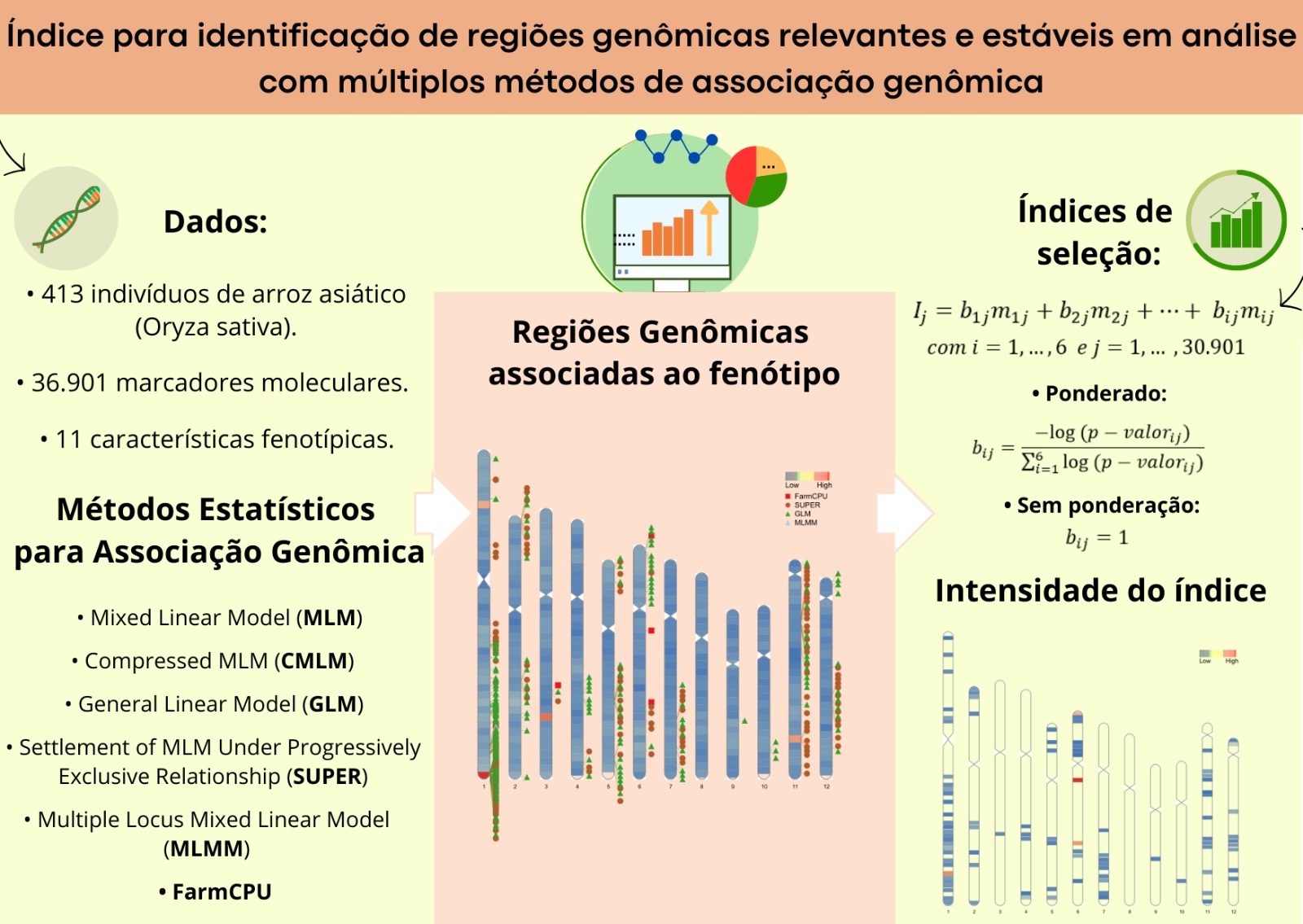
A Associação Genômica Ampla (Genome Wide Association Studies – GWAS) visa identificar associações entre loci de características quantitativas (Quantitative Trait Loci – QTL) e fenótipos. Esses estudos são de interesse para programas de melhoramento genético, pois possibilitam a identificação de marcadores associados a fenótipos de importância agronômica. Os métodos comumente utilizados na GWAS incluem Mixed Linear Model (MLM), Compressed MLM (CMLM), General Linear Model (GLM), Settlement of MLM Under Progressively Exclusive Relationship (SUPER), Multiple Locus Mixed Linear Model (MLMM), e FarmCPU. Este estudo teve como objetivo desenvolver dois índices, um sem ponderação e outro ponderado pela importância de cada região, para identificar regiões genômicas significativas e estáveis entre os métodos estatísticos aplicados à GWAS. O intuito foi minimizar a detecção de regiões potencialmente falsas positivas. A análise foi realizada em um conjunto de dados composto por 413 indivíduos de arroz asiático (Oryza sativa), genotipados com 36.901 SNPs (Single Nucleotide Polymorphisms). Foram avaliadas 11 características fenotípicas, e os seis métodos mencionados foram comparados. Entre as características analisadas, quatro se destacaram por apresentarem mais regiões genômicas significativas detectadas por um maior número de métodos. Os métodos SUPER e GLM se mostraram os mais eficazes na detecção de associações genômicas. Os índices detectaram regiões genômicas descritas na literatura, associadas às características como resistência à brusone, fertilidade e altura. O índice ponderado demostrou maior sensibilidade na detecção de regiões genômicas significativas, devido à atribuição dos pesos, que priorizou as regiões mais importantes.
Referências
AKHATAR, J.; BANGA, S. S. Genome-wide association mapping for grain yield components and root traits in Brassica juncea (L.) Czern & Coss. Molecular Breeding, v. 35, n. 1, p. 48, 2015.
AMMIRAJU, J. S. S. et al. The Oryza bacterial artificial chromosome library resource: construction and analysis of 12 deep-coverage large-insert BAC libraries that represent the 10 genome types of the genus Oryza. Genome research, v. 16, n. 1, p. 140–147, jan. 2006.
BOOPATHI, N. M. Genetic Mapping and Marker Assisted Selection: Basics, Practice and Benefits. In: Singapore: Springer, 2020. p. 343–388.
ESPOSITO, S. et al. Simultaneous improvement of grain yield and grain protein concentration in durum wheat by using association tests and weighted GBLUP. TAG. Theoretical and applied genetics. Theoretische und angewandte Genetik, v. 136, n. 12, 1 dez. 2023.
FUKUOKA, S.; OKUNO, K. QTL analysis and mapping of pi21, a recessive gene for field resistance to rice blast in Japanese upland rice. Theoretical and Applied Genetics, v. 103, n. 2, p. 185–190, 2001.
HALDAR, T.; GHOSH, S. Effect of Population Stratification On False Positive Rates Of Population-based Association Analyses Of Quantitative Traits. Annals of Human Genetics, v. 76, n. 3, p. 237, maio 2012.
HAZEL, L. N. THE GENETIC BASIS FOR CONSTRUCTING SELECTION INDEXES. Genetics, v. 28, n. 6, p. 476–490, 20 nov. 1943.
KALER, A. S. et al. Comparing Different Statistical Models and Multiple Testing Corrections for Association Mapping in Soybean and Maize. Frontiers in Plant Science, v. 10, 2020.
LI, M. et al. Enrichment of statistical power for genome-wide association studies. BMC Biology, v.12, n. 1, p. 73, 2014.
LIU, X. et al. Iterative Usage of Fixed and Random Effect Models for Powerful and Efficient Genome-Wide Association Studies. PLOS Genetics, v. 12, n. 2, p. e1005767, 1 fev. 2016.
MALIK, P. et al. Single-trait, multi-locus and multi-trait GWAS using four different models for yield traits in bread wheat. Molecular Breeding, v. 41, n. 7, p. 46, 2021
MARRI, P. R. et al. Identification and mapping of yield and yield related QTLs from an Indian accession of Oryza rufipogon. BMC Genetics, v. 6, n. 1, p. 33, 2005.
MEI, H. W. et al. Gene actions of QTLs affecting several agronomic traits resolved in a recombinant inbred rice population and two testcross populations. Theoretical and Applied Genetics, v. 107, n. 1, p. 89–101, 2003.
O’CONNOR, K. et al. Genome-wide association studies for yield component traits in a macadamia breeding population. BMC Genomics, v. 21, n. 1, p. 199, 2020.
PRICE, A. L. et al. Principal components analysis corrects for stratification in genome-wide association studies. Nature Genetics 2006 38:8, v. 38, n. 8, p. 904–909, 23 jul. 2006.
SEGURA, V. et al. An efficient multi-locus mixed-model approach for genome-wide association studies in structured populations. Nature Genetics, v. 44, n. 7, p. 825–830, 2012.
SMITH, H. F. A DISCRIMINANT FUNCTION FOR PLANT SELECTION. Annals of Eugenics, v. 7, n. 3, p. 240–250, 1 nov. 1936.
SU, G. et al. Comparison of genomic predictions using genomic relationship matrices built with different weighting factors to account for locus-specific variances. Journal of Dairy Science, v. 97, n. 10, p. 6547–6559, 2014.
SUELA, M. M. et al. Regional heritability mapping and genome-wide association identify loci for rice traits. Crop Science, v. 62, n. 2, p. 839–858, 1 mar. 2022.
TEISSIER, M. et al. Use of meta-analyses and joint analyses to select variants in whole genome sequences for genomic evaluation: An application in milk production of French dairy cattle breeds. Journal of Dairy Science, v. 101, n. 4, p. 3126–3139, 2018.
TIBBS CORTES, L.; ZHANG, Z.; YU, J. Status and prospects of genome-wide association studies in plants. The Plant Genome, v. 14, n. 1, p. e20077, 1 mar. 2021.
TRYNKA, G. et al. Disentangling the Effects of Colocalizing Genomic Annotations to Functionally Prioritize Non-coding Variants within Complex-Trait Loci. The American Journal of Human Genetics, v. 97, n. 1, p. 139–152, 2 jul. 2015.
VANRADEN, P. M. Efficient Methods to Compute Genomic Predictions. Journal of Dairy Science, v. 91, n. 11, p. 4414–4423, 2008.
WANG, G. L. et al. RFLP mapping of genes conferring complete and partial resistance to blast in a durably resistant rice cultivar. Genetics, v. 136, n. 4, p. 1421–1434, 1 abr. 1994.
WANG, J.; ZHANG, Z. GAPIT Version 3: Boosting Power and Accuracy for Genomic Association and Prediction. Genomics, Proteomics & Bioinformatics, v. 19, n. 4, p. 629–640, 1 ago. 2021.
WANG, Q. et al. A SUPER Powerful Method for Genome Wide Association Study. PLoS ONE, v. 9, n. 9, p. e107684, 23 set. 2014.
WOJCIK, G. L. et al. Genetic analyses of diverse populations improves discovery for complex traits. Nature, v. 570, n. 7762, p. 514–518, 2019.
XIONG, X. et al. Genetic dissection of maize (Zea mays L.) chlorophyll content using multi-locus genome-wide association studies. BMC Genomics, v. 24, n. 1, p. 384, 2023.
YU, J. et al. A unified mixed-model method for association mapping that accounts for multiple levels of relatedness. Nature Genetics, v. 38, n. 2, p. 203–208, 2006.
ZENG, A. et al. Genome-wide association study (GWAS) of salt tolerance in worldwide soybean germplasm lines. Molecular Breeding, v. 37, n. 3, p. 30, 2017.
ZHANG, Y. et al. Os MPH1 regulates plant height and improves grain yield in rice. PLOS ONE, v. 12, n. 7, p. e0180825, 14 jul. 2017.
ZHANG, Z. et al. Mixed linear model approach adapted for genome-wide association studies. Nature Genetics, v. 42, n. 4, p. 355–360, 2010.
ZHAO, K. et al. Genome-wide association mapping reveals a rich genetic architecture of complex traits in Oryza sativa. Nature Communications, v. 2, n. 1, p. 467, 2011.
ZHONG, H. et al. Uncovering the genetic mechanisms regulating panicle architecture in rice with GPWAS and GWAS. BMC Genomics, v. 22, n. 1, p. 86, 2021.
Downloads
Publicado
Como Citar
Edição
Seção
Licença
Proposta de Política para Periódicos de Acesso Livre
Autores que publicam nesta revista concordam com os seguintes termos:
- Autores mantém os direitos autorais e concedem à revista o direito de primeira publicação, com o trabalho simultaneamente licenciado sob a Licença Creative Commons Attribution que permite o compartilhamento do trabalho com reconhecimento da autoria e publicação inicial nesta revista.
- Autores têm autorização para assumir contratos adicionais separadamente, para distribuição não-exclusiva da versão do trabalho publicada nesta revista (ex.: publicar em repositório institucional ou como capítulo de livro), com reconhecimento de autoria e publicação inicial nesta revista.
- Autores têm permissão e são estimulados a publicar e distribuir seu trabalho online (ex.: em repositórios institucionais ou na sua página pessoal) a qualquer ponto antes ou durante o processo editorial, já que isso pode gerar alterações produtivas, bem como aumentar o impacto e a citação do trabalho publicado (Veja O Efeito do Acesso Livre).