Modelling and Simulations of a Couple Stress Fluid Flow and Heat Transfer in Inclined Geometry
DOI:
https://doi.org/10.29327/2520355.14.4-5Palavras-chave:
Couple stress fluid, Thin film flow, Homotopy perturbation method, Heat transferResumo
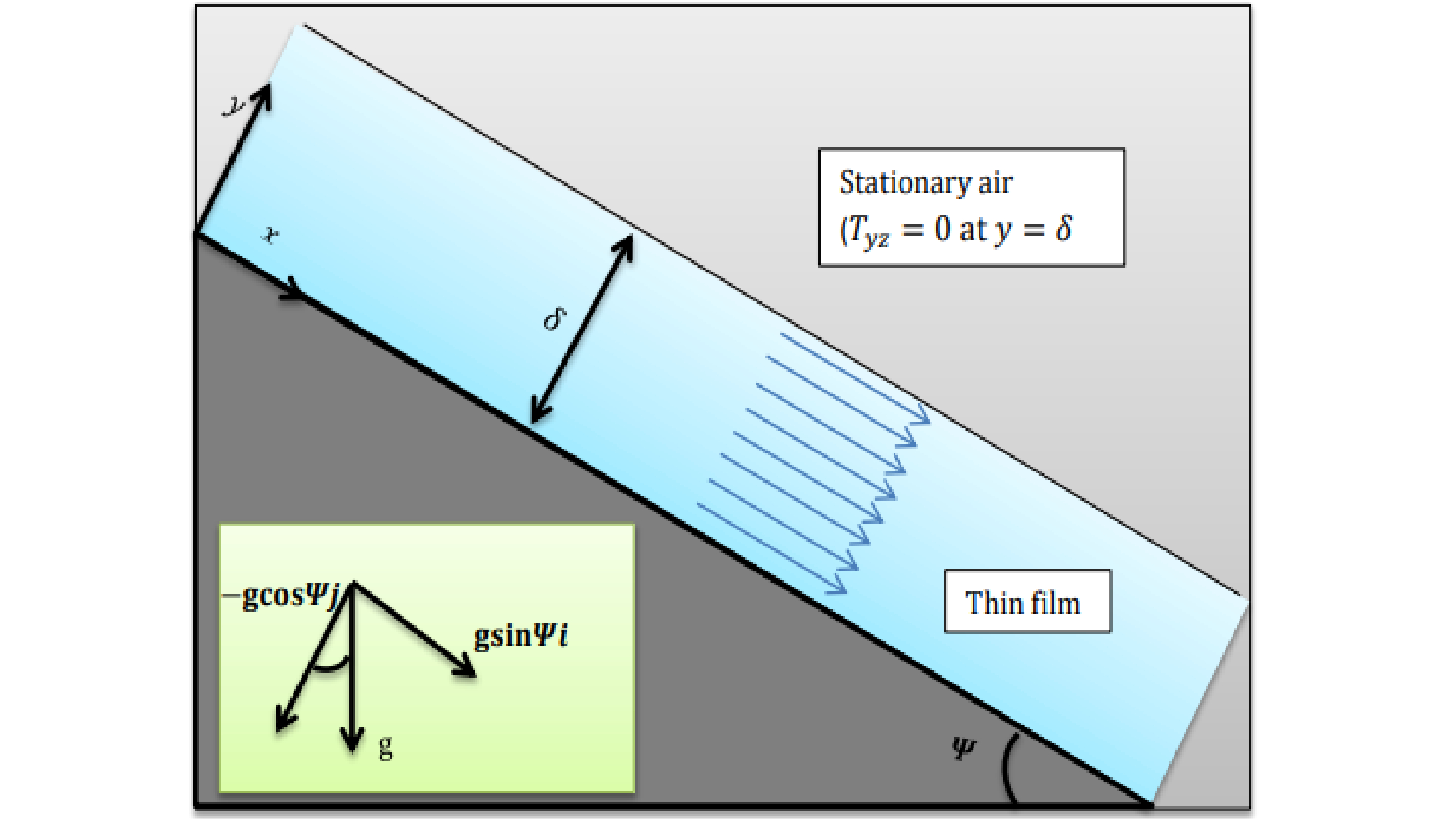
The study of couple stress fluid flow and heat transfer in inclined geometries is crucial in understanding various engineering applications, such as heat exchangers, lubrication systems, and biomedical devices. The interplay of fluid flow, heat transfer, and geometry creates complex, challenging problems that make accurate prediction of these phenomena difficult, requiring advanced techniques and models. This study aims to address these challenges by developing a comprehensive numerical model for simulating couple stress fluid flow and heat transfer in inclined geometry. From the momentum, continuity, and energy equations, we have derived strongly nonlinear ordinary differential equations. The Homotopy Perturbation Method (HPM) is applied to solve the governing coupled nonlinear differential equations with appropriate boundary conditions. The solutions yield expressions for the velocity profile, temperature distribution, vorticity, volume flow rate, shear stress, and average velocity. Numerical and graphical comparisons of the effects of various parameters on temperature and velocity show good agreement with exact solutions.
Referências
AI, L.; VAFAI, K. An investigation of Stokes' second problem for non-Newtonian fluids. Numerical Heat Transfer, Part A, v. 47, n. 10, p. 955–980, 2005.
ALAM, M. K.; SIDDIQUI, A. M.; RAHIM, M. T.; ISLAM, S. Thin-film flow of magnetohydrodynamic (MHD) Johnson–Segalman fluid on vertical surfaces using the Adomian decomposition method. Applied Mathematics and Computation, v. 219, n. 8, p. 3956–3974, 2012.
ELDABE, N. T. M.; HASSAN, A. A.; MOHAMED, M. A. Effect of couple stresses on the MHD of a non-Newtonian unsteady flow between two parallel porous plates. Zeitschrift für Naturforschung A, v. 58, n. 4, p. 204–210, 2003.
FAROOQ, M.; RAHIM, M. T.; ISLAM, S.; SIDDIQUI, A. M. Withdrawal and drainage of generalized second grade fluid on vertical cylinder with slip conditions. Journal of Prime Research in Mathematics, v. 9, n. 1, p. 51–64, 2013.
FETECAU, C.; FETECAU, C. The first problem of Stokes for an Oldroyd-B fluid. International Journal of Non-Linear Mechanics, v. 38, n. 10, p. 1539–1544, 2003.
GUL, T.; KHAN, Z. Thin film Maxwell-Power Law Fluid Flow on an extending surface. City University International Journal of Computational Analysis, v. 6, n. 1, p. 1–10, 2023.
HAYAT, T.; SAJID, M. On analytic solution for thin film flow of a fourth grade fluid down a vertical cylinder. Physics Letters A, v. 361, n. 4-5, p. 316–322, 2007.
ISLAM, S.; ALI, I.; RAN, X. J.; SHAH, A.; SIDDIQUI, A. M. Effects of couple stresses on Couette and Poiseuille flow. International Journal of Nonlinear Science and Numerical Simulation, v. 10, n. 1, p. 99–112, 2009.
ISLAM, S.; ZHOU, C. Y. Exact solutions for two dimensional flows of couple stress fluids. Zeitschrift für angewandte Mathematik und Physik, v. 58, n. 6, p. 1035–1048, 2007.
MAHESH, T.; KAMMAPPA, Z.; PANDA, S. Modeling and analysis of a generalized second-grade thin liquid film flowing over a heated incline. Journal of Engineering Mathematics, v. 150, n. 1, p. 11, 2025.
MUNSON, B. R.; YOUNG, D. F.; OKIISHI, T. H. Fundamentals of fluid mechanics. 1. ed. New York: Wiley, 1990.
SAJID, M. et al. On exact solutions for thin film flows of a micropolar fluid. Communications in Nonlinear Science and Numerical Simulation, v. 14, n. 2, p. 451–461, 2009.
SHAH, R. A.; ISLAM, S.; SIDDIQUI, A. M.; HAROON, T. Heat transfer by laminar flow of an elastico-viscous fluid in posttreatment analysis of wire coating with linearly varying temperature along the coated wire. Heat and Mass Transfer, v. 48, p. 903–914, 2012.
SIDDIQUI, A. M.; AHMED, M.; GHORI, Q. K. Couette and Poiseuille flows for non-Newtonian fluids. International Journal of Nonlinear Sciences and Numerical Simulation, v. 7, n. 1, p. 15–26, 2006.
SIDDIQUI, A. M.; AHMED, M.; GHORI, Q. K. Thin film flow of non-Newtonian fluids on a moving belt. Chaos, Solitons & Fractals, v. 33, n. 3, p. 1006–1016, 2007.
SIDDIQUI, A. M.; MAHMOOD, R.; GHORI, Q. K. Some exact solutions for the thin film flow of a PTT fluid. Physics Letters A, v. 356, n. 4-5, p. 353–356, 2006.
SIDDIQUI, A. M.; MAHMOOD, R.; GHORI, Q. K. Homotopy perturbation method for thin film flow of a third grade fluid down an inclined plane. Chaos, Solitons & Fractals, v. 35, n. 1, p. 140–147, 2008.
SIDDIQUI, A. M.; ZEB, A.; GHORI, Q. K.; BENHABIT, A. M. Homotopy perturbation method for heat transfer flow of a third grade fluid between parallel plates. Chaos, Solitons & Fractals, v.36, n. 1, p. 182–192, 2008.
SIDDIQUI, A. M.; MAHMOOD, R.; GHORI, Q. K. Homotopy perturbation method for thin film flow of a fourth grade fluid down a vertical cylinder. Physics Letters A, v. 352, n. 4-5, p. 404–410, 2006.
ULLAH, Z.; ALAM, M. M.; YOUNIS, J.; ELHAG, S. H.; HUSSAIN, A.; HAIDER, I. Computational study of heat and mass transfer with Soret/Dufour effects on power-law magneto nanofluid flow along stretching surface. AIP Advances, v. 14, n. 9, 2024.
VERMA, A. K. Numerical investigation of unsteady magnetohydrodynamic flow of a Newtonian fluid with variable viscosity in an inclined channel. Physics of Fluids, v. 37, n. 1, 2025.
WEINSTEIN, S. J.; RUSCHAK, K. J.; NG, K. C. Developing flow of a power-law liquid film on an inclined plane. Physics of Fluids, v. 15, n. 10, p. 2973–2986, 2003.
Downloads
Publicado
Como Citar
Edição
Seção
Licença
Proposta de Política para Periódicos de Acesso Livre
Autores que publicam nesta revista concordam com os seguintes termos:
- Autores mantém os direitos autorais e concedem à revista o direito de primeira publicação, com o trabalho simultaneamente licenciado sob a Licença Creative Commons Attribution que permite o compartilhamento do trabalho com reconhecimento da autoria e publicação inicial nesta revista.
- Autores têm autorização para assumir contratos adicionais separadamente, para distribuição não-exclusiva da versão do trabalho publicada nesta revista (ex.: publicar em repositório institucional ou como capítulo de livro), com reconhecimento de autoria e publicação inicial nesta revista.
- Autores têm permissão e são estimulados a publicar e distribuir seu trabalho online (ex.: em repositórios institucionais ou na sua página pessoal) a qualquer ponto antes ou durante o processo editorial, já que isso pode gerar alterações produtivas, bem como aumentar o impacto e a citação do trabalho publicado (Veja O Efeito do Acesso Livre).