Optimal Buffer and Server Allocation in Markovian Queueing Networks by Particle Swarm Algorithm
Palavras-chave:
Queueing Theory, Servers, Buffers, Heuristic Optimization, Particle Swarm OptimizationResumo
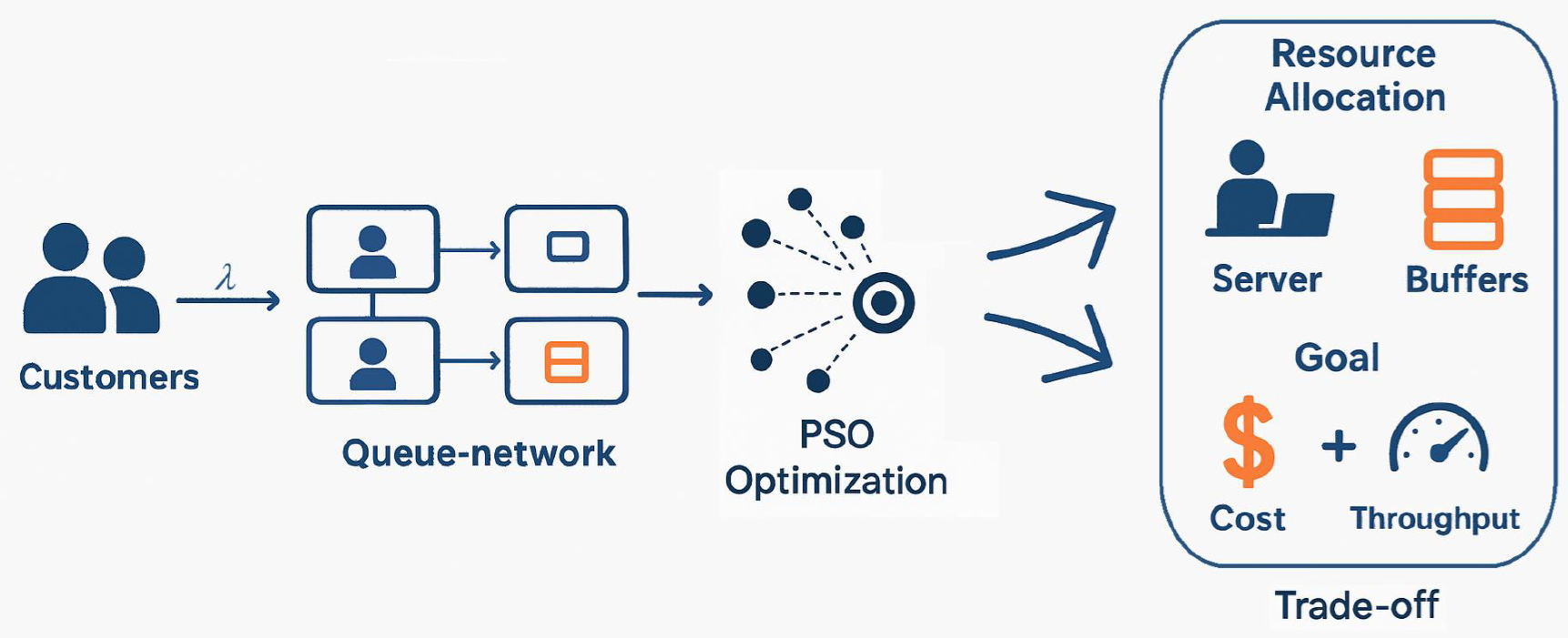
This study optimizes resource allocation in queueing network systems to improve operational efficiency using appropriate algorithms. Specifically, Particle Swarm Optimization (PSO) was applied to the buffer and server allocation problem (BSAP) in queueing networks with Markovian arrivals and service times, multiple servers, and finite buffers. In this context, the buffer and server allocation problem (BSAP) stands out, whose solution methodology can be applied to various real-world situations modeled as queues or queueing networks, such as manufacturing line systems, healthcare services, traffic models, among others. BSAP is computationally challenging as a nonlinear programming problem without a closed-form analytical solution, necessitating derivative-free methods like PSO. The PSO algorithm is considered a promising tool for finding efficient solutions, thus enabling improved resource management. The study examines the algorithm’s ability to deliver cost-effective and suitable solutions that accommodate variations in relative costs between servers and buffers, as well as the specific characteristics of each network topology.
Referências
ABENSUR, E. O. Banking operations using queuing theory and genetic algorithms. Produto & Produção, v. 12, n. 2, 2011.
CARTER, M.; PRICE, C. C.; RABADI, G. Operations research: a practical introduction. [S.l.]: Chapman and Hall/CRC, 2018.
COELLO, C. A. C.; LECHUGA, M. S. MOPSO: A proposal for multiple objective particle swarm optimization. In: Proceedings of the 2002 Congress on Evolutionary Computation. CEC’02 (Cat. No.02TH8600). [S.l.: s.n.], 2002. v. 2, p. 1051–1056.
COLLETTE, Y.; SIARRY, P. Multiobjective optimization: principles and case studies. OR/MS Today, Institute for Operations Research and the Management Sciences, v. 31, n. 1, p. 60–61, 2004.
CRUZ, F. R. B.; DUARTE, A. R.; SOUZA, G. L. Multi-objective performance improvements of general finite single-server queueing networks. Journal of Heuristics, Springer, v. 24, n. 5, p. 757–781, 2018.
CRUZ, F. R. B.; KENDALL, G.; WHILE, L.; DUARTE, A. R.; BRITO, N. C. L. Throughput maximization of queueing networks with simultaneous minimization of service rates and buffers. Mathematical Problems in Engineering, Hindawi, v. 2012 - Article ID 692593, p. 19 pages, 2012.
DEB, K. Optimization for engineering design: Algorithms and examples. [S.l.]: PHI Learning Pvt. Ltd., 2012.
DEB, K.; PRATAP, A.; AGARWAL, S.; MEYARIVAN, T. A fast and elitist multiobjective genetic algorithm: Nsga-ii. IEEE transactions on evolutionary computation, IEEE, v. 6, n. 2, p. 182–197, 2002.
DUARTE, A. R. The server allocation problem for Markovian queueing networks. International Journal of Services and Operations Management, v. 48, n. 2, p. 256–271, 2024.
DUARTE, A. R.; CRUZ, F. R. B.; SOUZA, G. L. A greedy post-processing strategy for multiobjective performance optimization of general single-server finite queueing networks. Soft Computing, Springer, v. 28, n. 17, p. 9483–9494, 2024.
GHIMIRE, S.; THAPA, G. B.; GHIMIRE, R. P.; SILVESTROV, S. A survey on queueing systems with mathematical models and applications. American Journal of Operation Research, v. 7, n. 1, p. 1–14, 2017.
GROSS, D.; SHORTLE, J. F.; M., T. J.; M., H. C. Fundamentals of Queueing Theory. 4th edition. ed. New York, NY: Wiley - Interscience, 2009.
JAIN, M.; SAIHJPAL, V.; SINGH, N.; SINGH, S. B. An overview of variants and advancements of pso algorithm. Applied Sciences, MDPI, v. 12, n. 17, p. 8392, 2022.
KENDALL, D. G. Stochastic processes occurring in the theory of queues and their analysis by the method of embedded Markov chains. Annals Mathematical Statistics, v. 24, p. 338–354, 1953.
KENNEDY, J.; EBERHART, R. Particle swarm optimization. In: Neural Networks, 1995. Proceedings., IEEE International Conference on. [S.l.: s.n.], 1995. v. 4, p. 1942–1948.
MISEREZ, J.; COLLE, D.; PICKAVET, M.; TAVERNIER, W. Exploiting queue information for scalable delay-constrained routing in deterministic networks. IEEE Transactions on Network and Service Management, IEEE, 2024
R CORE TEAM. R: A Language and Environment for Statistical Computing. Vienna, Austria, 2021. Disponível em: ⟨https://www.R-project.org/⟩.
RINGUEST, J. L. Multiobjective optimization: behavioral and computational considerations. [S.l.]: Springer Science & Business Media, 2012.
SHARMA, S.; KUMAR, V. A comprehensive review on multi-objective optimization techniques: Past, present and future. Archives of Computational Methods in Engineering,Springer, v. 29, n. 7, p. 5605–5633, 2022.
SMITH, J. M.; CRUZ, F. R. B. The buffer allocation problem for general finite buffer queueing networks. IIE Transactions, v. 37, n. 4, p. 343–365, 2005.
SOUZA, G. L.; DUARTE, A. R.; MOREIRA, G. J. P.; CRUZ, F. R. B. A novel formulation for multi-objective optimization of general finite single-server queueing networks. In: IEEE. Proceedings of the 2020 Congress on Evolutionary Computation. CEC’20. [S.l.], 2020. p. 1–8.
VAN WOENSEL, T.; ANDRIANSYAH, R.; CRUZ, F. R. B.; J., M. S.; KERBACHE, L. Buffer and server allocation in general multi-server queueing networks. International Transactions in Operational Research, Wiley Online Library, v. 17, n. 2, p. 257–286, 2010.
WICKHAM, H. ggplot2: Elegant Graphics for Data Analysis. Springer-Verlag New York, 2016. ISBN 978-3-319-24277-4. Dispon´ıvel em: ⟨https://ggplot2.tidyverse.org⟩.
YANG, X. S. Engineering Optimization: An Introduction with Metaheuristic Applications. 1st. ed. [S.l.]: Wiley Publishing, 2010. ISBN 0470582464, 9780470582466.
ZHONG, Z.; CAO, P.; HUANG, J.; ZHOU, S. X. Capacity allocation and scheduling in twostage service systems with multiclass customers. Manufacturing & Service Operations Management, INFORMS, v. 26, n. 5, p. 1842–1859, 2024.
Downloads
Publicado
Como Citar
Edição
Seção
Licença
Proposta de Política para Periódicos de Acesso Livre
Autores que publicam nesta revista concordam com os seguintes termos:
- Autores mantém os direitos autorais e concedem à revista o direito de primeira publicação, com o trabalho simultaneamente licenciado sob a Licença Creative Commons Attribution que permite o compartilhamento do trabalho com reconhecimento da autoria e publicação inicial nesta revista.
- Autores têm autorização para assumir contratos adicionais separadamente, para distribuição não-exclusiva da versão do trabalho publicada nesta revista (ex.: publicar em repositório institucional ou como capítulo de livro), com reconhecimento de autoria e publicação inicial nesta revista.
- Autores têm permissão e são estimulados a publicar e distribuir seu trabalho online (ex.: em repositórios institucionais ou na sua página pessoal) a qualquer ponto antes ou durante o processo editorial, já que isso pode gerar alterações produtivas, bem como aumentar o impacto e a citação do trabalho publicado (Veja O Efeito do Acesso Livre).