Association between scientific initiation and success in postgraduate studies
Palavras-chave:
Postgraduate studies, Scientific initiation, Data science, Logistic regression, School dropoutResumo
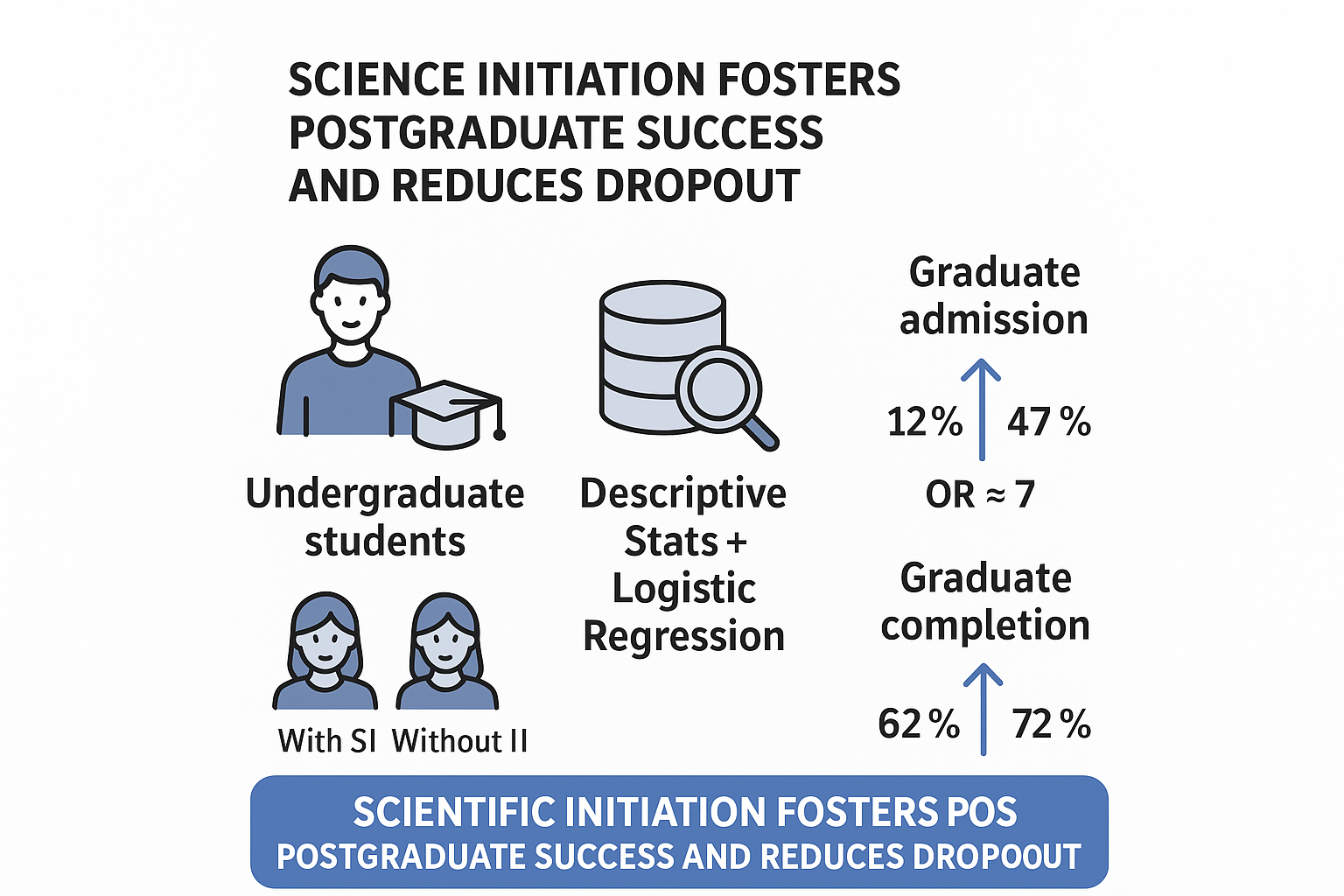
This study investigates the relationship between participation in Scientific Initiation (SI) and admission and success rates in graduate programs at the Federal University of Viçosa (UFV). The research was motivated by the need to understand the factors that influence access and academic continuity, especially in the Brazilian context, where graduate school dropout rates pose a challenge for both students and institutions. Using descriptive statistics and logistic regression techniques, data were obtained through the Federal University of Vic¸osa’s open data portal, and specific data were analyzed using R software. Variables such as age, gender, state of origin, and academic standing were examined, enabling the identification of patterns and trends in student trajectories. It was possible to draw an average profile of UFV students, both at the undergraduate and graduate levels, and to assess the relationship between scientific initiation and graduate studies. The results indicate that participation in scientific initiation has a positive association with admission to graduate studies. Students who participated in scientific initiation during their undergraduate years had a significantly higher rate of academic continuation compared to those who did not participate in this program. The results of this research underscore the importance of institutional policies that encourage scientific initiation, promoting greater academic engagement and contributing to a reduction in dropout rates in graduate programs. The study also contributes to the knowledge base on the relationship between scientific initiation and retention in graduate programs.
Referências
AGRESTI A.; KATERI, M. Categorical data analysis. In: International encyclopedia of statistical science. [S.l.]: Springer, 2011. p. 206–208.
BASTOS F.; MARTINS, F. A. M. T. M. L. C. S. A importância da iniciação científica para os alunos de graduação em biomedicina. Revista Eletronica Novo Enfoque , v. 11, n. 11, p. 61–66, 2010.
DANTAS, E. H. F. Formação de recursos humanos para pesquisa: avaliação do impacto do programa institucional de bolsas de iniciação científica na pós-graduação da ufrn. 2019.
LIMA, L. G. A. A influência da iniciação científica sobre a pós-graduação: um estudo de caso sobre tempo, idade de titulação e produção científica. 2016.
LORDELO, J. A. C.; ARGoLO, R. F. Influências da iniciação científica na pós-graduação Estudos em Avaliação Educacional, v. 26, n. 61, p. 168–191, 2015.
MASSI L.; QUEIROZ, S. L. Estudos sobre iniciação científica no brasil: uma revisão. Cadernos de Pesquisa, v. 40, n. 139, p. 173–197, 2010.
MONTGOMERY, D. C. Design and analysis of experiments. Hoboken: John Wiley & Sons, 2017.
PELINSKI J. D.; KAMPA, A. Efeito da iniciação científica no rendimento acadêmico e na inserção em programas de pós-graduação “stricto sensu”: uma análise com propensity score matching. Universidade Estadual de Ponta Grossa, 2021.
SILVA P. S. B.; BIN, A. da. O impacto da iniciação científica na pós-graduação. Seminarios do LEG, n. 8, p. 93–99, 2019.
Downloads
Publicado
Como Citar
Edição
Seção
Licença
Proposta de Política para Periódicos de Acesso Livre
Autores que publicam nesta revista concordam com os seguintes termos:
- Autores mantém os direitos autorais e concedem à revista o direito de primeira publicação, com o trabalho simultaneamente licenciado sob a Licença Creative Commons Attribution que permite o compartilhamento do trabalho com reconhecimento da autoria e publicação inicial nesta revista.
- Autores têm autorização para assumir contratos adicionais separadamente, para distribuição não-exclusiva da versão do trabalho publicada nesta revista (ex.: publicar em repositório institucional ou como capítulo de livro), com reconhecimento de autoria e publicação inicial nesta revista.
- Autores têm permissão e são estimulados a publicar e distribuir seu trabalho online (ex.: em repositórios institucionais ou na sua página pessoal) a qualquer ponto antes ou durante o processo editorial, já que isso pode gerar alterações produtivas, bem como aumentar o impacto e a citação do trabalho publicado (Veja O Efeito do Acesso Livre).