Tower of Hanoi in Mathematics classes: contributions to teaching geometric progression
DOI:
https://doi.org/10.29327/2520355.14.4-1Keywords:
Tower of Hanoi, Games in Education, Mathematics Education, Mathematical InvestigationAbstract
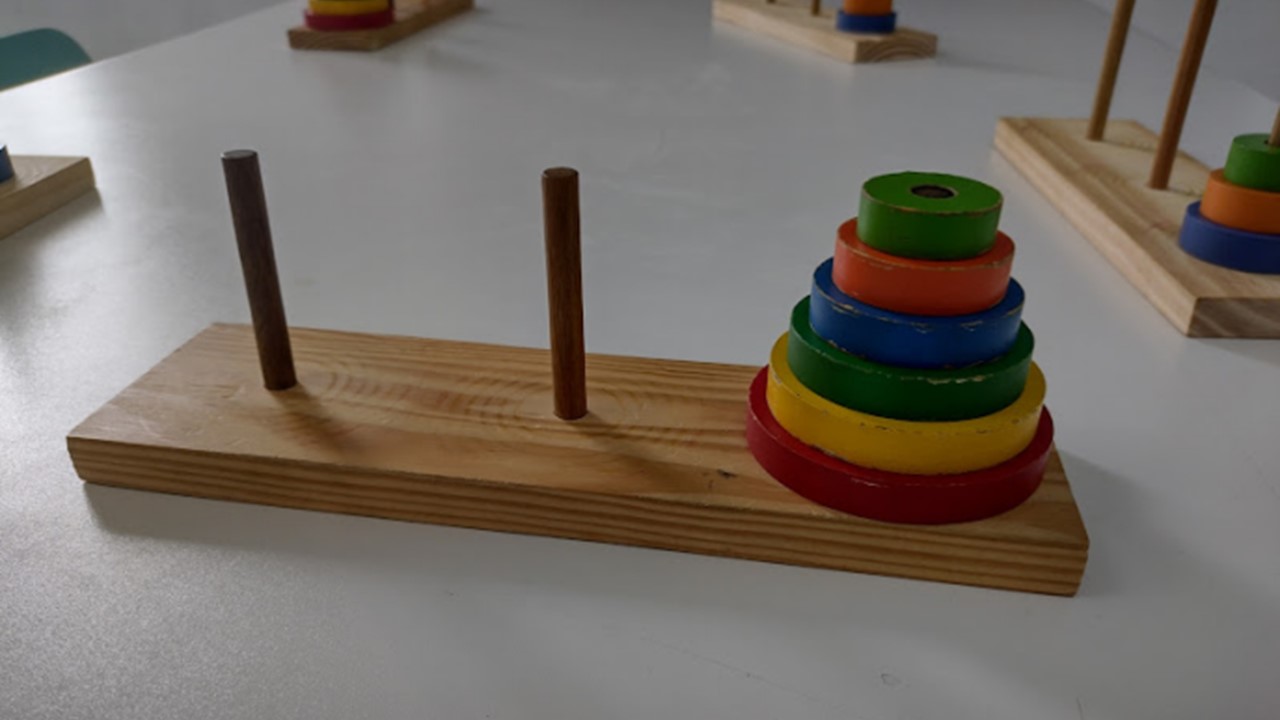
The Tower of Hanoi is a manipulable material that can promote learning of mathematical content, including sequences and geometric progression (BRASIL, 2018). The objective of this study is to report the results of a teaching intervention carried out at E. E. Samuel Engel, a partner in the Institutional Teaching Initiation Scholarship Program (PIBID) Mathematics. In order to relate the game with geometric progressions, the scholarship holders carried out an investigative activity with high school students, exploring the movements of the disks and possible patterns. Through group challenges, students were encouraged to find solutions with different numbers of disks in the Tower of Hanoi. We observed that, in the five classes, students identified patterns in the movements necessary to solve the game through exploration. Furthermore, in groups, they determined the minimum number of movements and, in some cases, mathematically generalized the calculation for any number of disks, using formulas and algorithms. In general, students welcomed the investigative approach, considering it more interesting than conventional classes. However, some groups found it difficult to formalize their reasoning and directly associate the Tower of Hanoi with geometric progressions, being helped by PIBID scholarship holders. The intervention, therefore, enabled students to establish connections between the theory of geometric progressions and the game, contributing to the consolidation of the content. Therefore, this study highlights the importance of activities involving manipulable materials, games, and mathematical investigation as drivers of learning in high school.
References
BRASIL. Ministério da Educação. Base Nacional Comum Curricular. Brasília, 2018.
CAPES. PIBID. 2023. Disponível em: <https://www.gov.br/capes/pt-br/acesso-a-informacao/acoes-e-programas/educacao-basica/pibid/pibid>. Acesso em: 11 jan. 2024
COSTA, A. Torre de Hanói, uma proposta de atividade para o ensino médio. In: XVI Encontro Regional de Estudantes de Matemática do Sul. Anais [EREMATSUL], Porto Alegre: EdiPUCRS, 2010. Disponível em: Acesso em: 18 ago. 2023.
LOPES, R. A.; FERREIRA, J. C. O que pode o Triângulo de Sierpinski em salas de aula do Novo Ensino Médio? SIGMAE, v. 13, p. 1-21, 2024.
LOPES, R. A; QUEIROZ, C. R. O. Q. Influências e desdobramentos da monitoria acadêmica em disciplinas de Matemática em uma universidade federal: um olhar para as percepções dos estudantes. REMAT: Revista Eletrônica da Matemática, v. 10, p. e2001, 2024.
MINAS GERAIS. Secretaria de Estado da Educação. Currículo Referência de Minas Gerais - CRMG. Disponível em:
http://basenacionalcomum.mec.gov.br/images/implementacao/curriculos_estados/documento_curricular_mg.pdf. Acesso em: 04 jan. 2024.
PIBID - PROGRAMA INSTITUCIONAL DE BOLSA DE INICIAÇÃO À DOCÊNCIA.gov.br, 2013. Disponível em: https://www.gov.br/capes/pt-br/acesso-a-informacao/acoes-e-programas/educacao-basica/pibid/pibid. Acesso em: 11 jan. 2024
SKOVSMOSE, O. Cenários para Investigação. v.13. Rio Claro: Bolema, 2000. [1]
SKOVSMOSE, O. Um convite à educação matemática crítica. Brasil: Papirus Editora,2014.
Downloads
Published
Issue
Section
License
Proposta de Política para Periódicos de Acesso Livre
Autores que publicam nesta revista concordam com os seguintes termos:
- Autores mantém os direitos autorais e concedem à revista o direito de primeira publicação, com o trabalho simultaneamente licenciado sob a Licença Creative Commons Attribution que permite o compartilhamento do trabalho com reconhecimento da autoria e publicação inicial nesta revista.
- Autores têm autorização para assumir contratos adicionais separadamente, para distribuição não-exclusiva da versão do trabalho publicada nesta revista (ex.: publicar em repositório institucional ou como capítulo de livro), com reconhecimento de autoria e publicação inicial nesta revista.
- Autores têm permissão e são estimulados a publicar e distribuir seu trabalho online (ex.: em repositórios institucionais ou na sua página pessoal) a qualquer ponto antes ou durante o processo editorial, já que isso pode gerar alterações produtivas, bem como aumentar o impacto e a citação do trabalho publicado (Veja O Efeito do Acesso Livre).