Comparison of the goodness of fit of the Langmuir isotherm
DOI:
https://doi.org/10.29327/2520355.2.2-2Keywords:
Adsorption, Regression Analysis, Gauss-Newton method, Levenberg-MarquardtmethodAbstract
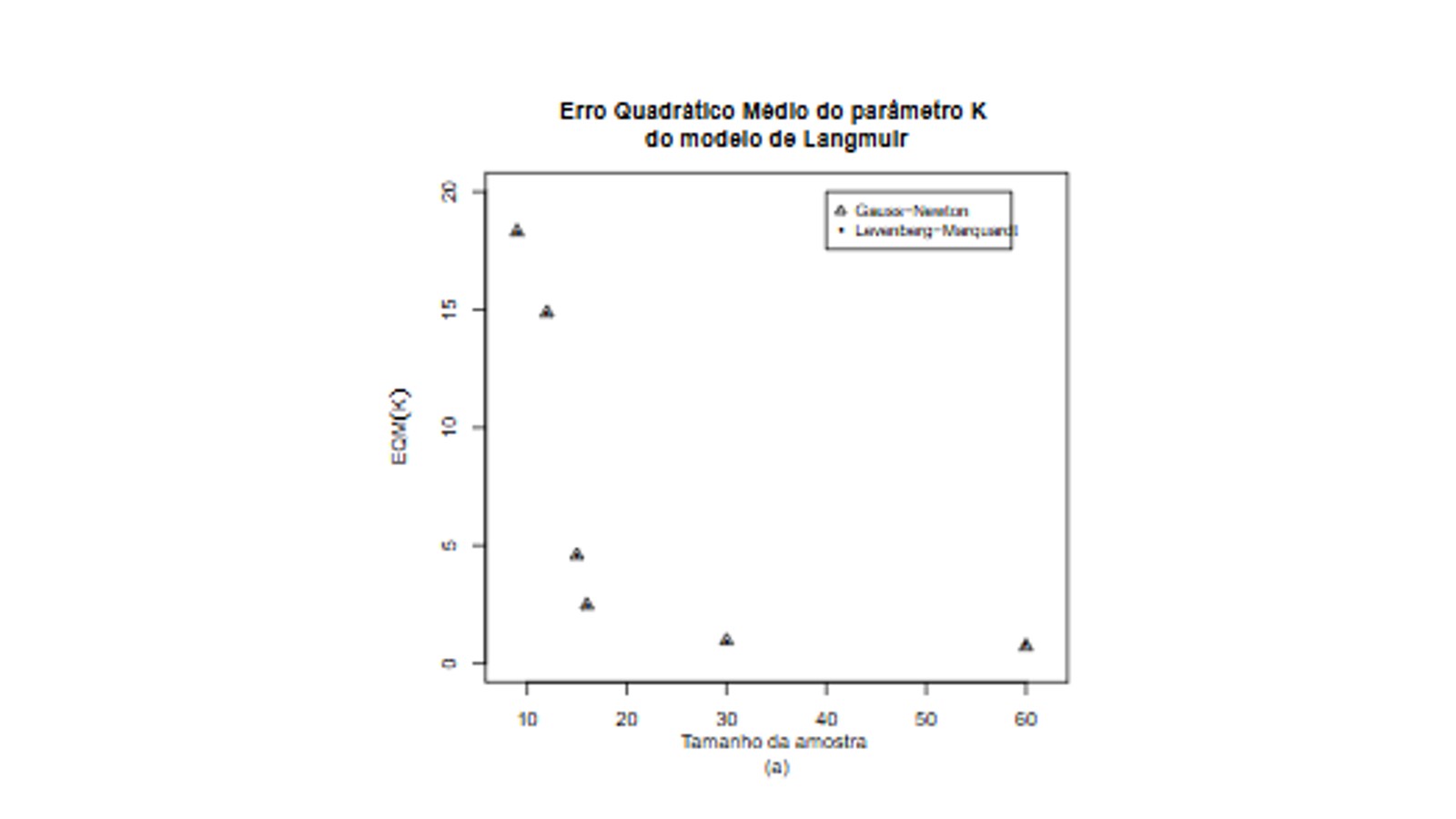
The objective of this work was to compare the estimates quality of the Langmuir isotherm parameters obtained via Gauss-Newton method and Levenberg-Marquardt method. To compare the estimates of the model parameters obtained by these two iterative numerical methods, were simulated 1000 data sets, with concentrations ranging from 0.5 to 100 and sample sizes of 9, 12, 15, 16, 30 and 60 from the Langmuir isotherm parameters with K = 2 . 96 and M = 0 . 91 . For the evaluation of estimates, the accuracy and precision of the Langmuir isotherm estimates by the Gauss-Newton and the Levenberg-Marquardt methods were analyzed. Accuracy was as- sessed using the average relative bias and the approximate accuracy by the mean square error. The results suggest that the two estimation methods have similar precision and accuracy to the sizes of the samples studied. How is it possible that the Gauss - Newton don’t converge or that the process is interrupted by the lack of unique solution of the linear system that determines the update of the parameter values, it is concluded the Levenberg-Marquardt method is more suitable for estimating the Langmuir isotherm parameters.References
ÁVILA, T. C. et al. Emprego de sílica gel organicamente modificada e impressa ionicamente para pré-concentração seletiva on-line de íons cobre. Química Nova, v. 33, n. 2, p. 301-308, 2010. Disponível em: <http://www.scielo.br/pdf/qn/v33n2/14.pdf>. Acesso em: 14 janeiro 2014.
BORBA, C. E. Modelagem da remoção de metais pesados em coluna de adsorção de leito fixo. 2006. 145 p. Dissertação (Mestrado em Engenharia Química) - Faculdade de Engenharia Química, Universidade Estadual de Campinas, Campinas. 2006.
ESPÍRITO SANTO, I. A. C. P. Modelação e Estimação de Parâmetros. 2001. 81 p. Componente de Síntese a apresentar nas Provas de Aptidão Pedagógica e Capacidade Científica - Engenharia de Produção e Sistemas - Universidade do Minho. Disponível em: <http://www.norg.uminho.pt/iapinho/public/sintese.pdf>. Acesso em: 7 fev. 2014.
FERREIRA, D. F. Estatística Básica. Lavras: Editora UFLA, 664p., 2009.
KLUG, M et al., Análise de isotermas de adsorção de Cu(II), Cd(II), Ni(II) e Zn(II) pela N-(3,4-dihidroxibenzil) Quitosana Empregando o método da Regressão Não linear. Química Nova, v.21, n.4, p. 410-413, 1998. Disponível em: <http://www.scielo.br/pdf/qn/v21n4/3 183.pdf>. Acesso em: 16 jan. 2014.
LEVENBERG, K. A method for the solution of certain problems in least squares. Quarterly of Applied Mathematics. v. 2, p. 164-168, 1944.
LOURAKIS, M. I. A.; ARGYROS, A. A. Is Levenberg-Marquardt the Most Efficient Optimization Algorithm for Implementing Bundle Adjustment?, IEEE International Conference on Computer Vision, ICCV05, v.2, p.1526-1531, Beijing, China, Oct. 2005.
MARQUARDT. D. W. An algorithm for least squares estimation of nonlinear parameters. Journal of the Society for Industrial and Applied Mathematics. v. 11, n. 2, p. 431-441, 1963.
MOUTA. et al. Adsorção de Selênio em Latossolos. Revista Brasileira de Ciência do Solo, v.32, n.3, p.1033-1041, 2008.
MONICO, J. F. G. et al. Acurácia e precisão: Revendo os conceitos de forma acurada. Boletim de Ciências Geodésicas, v. 15, n.3, p. 469-483, 2009.
R CORE TEAM. R: A language and environment for statistical computing. R Foundation for Statistical Computing, Vienna, Austria. 2012. ISBN 3-900051-07-0. <http://www.R-project.org/.
Downloads
Published
Issue
Section
License
Proposta de Política para Periódicos de Acesso Livre
Autores que publicam nesta revista concordam com os seguintes termos:
- Autores mantém os direitos autorais e concedem à revista o direito de primeira publicação, com o trabalho simultaneamente licenciado sob a Licença Creative Commons Attribution que permite o compartilhamento do trabalho com reconhecimento da autoria e publicação inicial nesta revista.
- Autores têm autorização para assumir contratos adicionais separadamente, para distribuição não-exclusiva da versão do trabalho publicada nesta revista (ex.: publicar em repositório institucional ou como capítulo de livro), com reconhecimento de autoria e publicação inicial nesta revista.
- Autores têm permissão e são estimulados a publicar e distribuir seu trabalho online (ex.: em repositórios institucionais ou na sua página pessoal) a qualquer ponto antes ou durante o processo editorial, já que isso pode gerar alterações produtivas, bem como aumentar o impacto e a citação do trabalho publicado (Veja O Efeito do Acesso Livre).